Show the full cost
Transparent pricing removes the fear of surprise charges.
Designing a unified platform that combines automotive e-commerce with contactless digital key technology to modernize vehicle ownership
Increase in Service Bookings
Digital Key Adoption
Faster Checkout Flow
App Store Rating
KOTO by Toyota
I designed one mobile experience for discovering services, booking care, and securely sharing vehicle access.
View the solutionThe problem
Owners searched for services without clear prices, coordinated appointments through calls and emails, then managed physical keys separately.
Hidden fees made it difficult to commit with confidence.
Booking stretched across calls and confirmations.
Physical key exchange complicated service and shared access.

The opportunity was not another booking tool. It was one continuous relationship between the owner, the car, and Toyota.
Research insight
Interviews with 20 vehicle owners, service-provider conversations, behavioral analysis, and competitive review revealed three conditions for digital adoption.
Transparent pricing removes the fear of surprise charges.
Availability, status, and reminders make booking predictable.
Visible permissions help digital keys feel secure.
Design decision
One account. One car. One continuous service relationship.
Final design
The visual system keeps high-value actions clear while the vehicle profile carries context across every task.
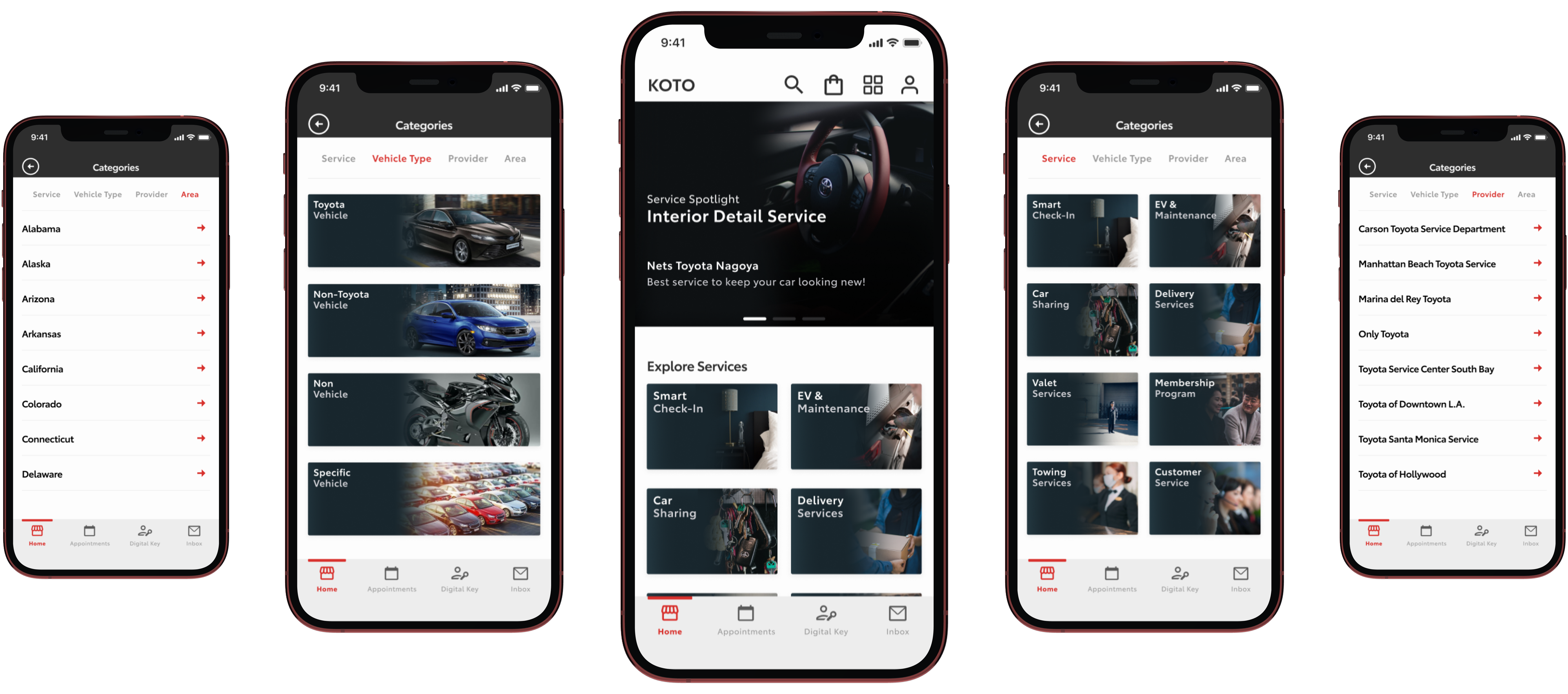
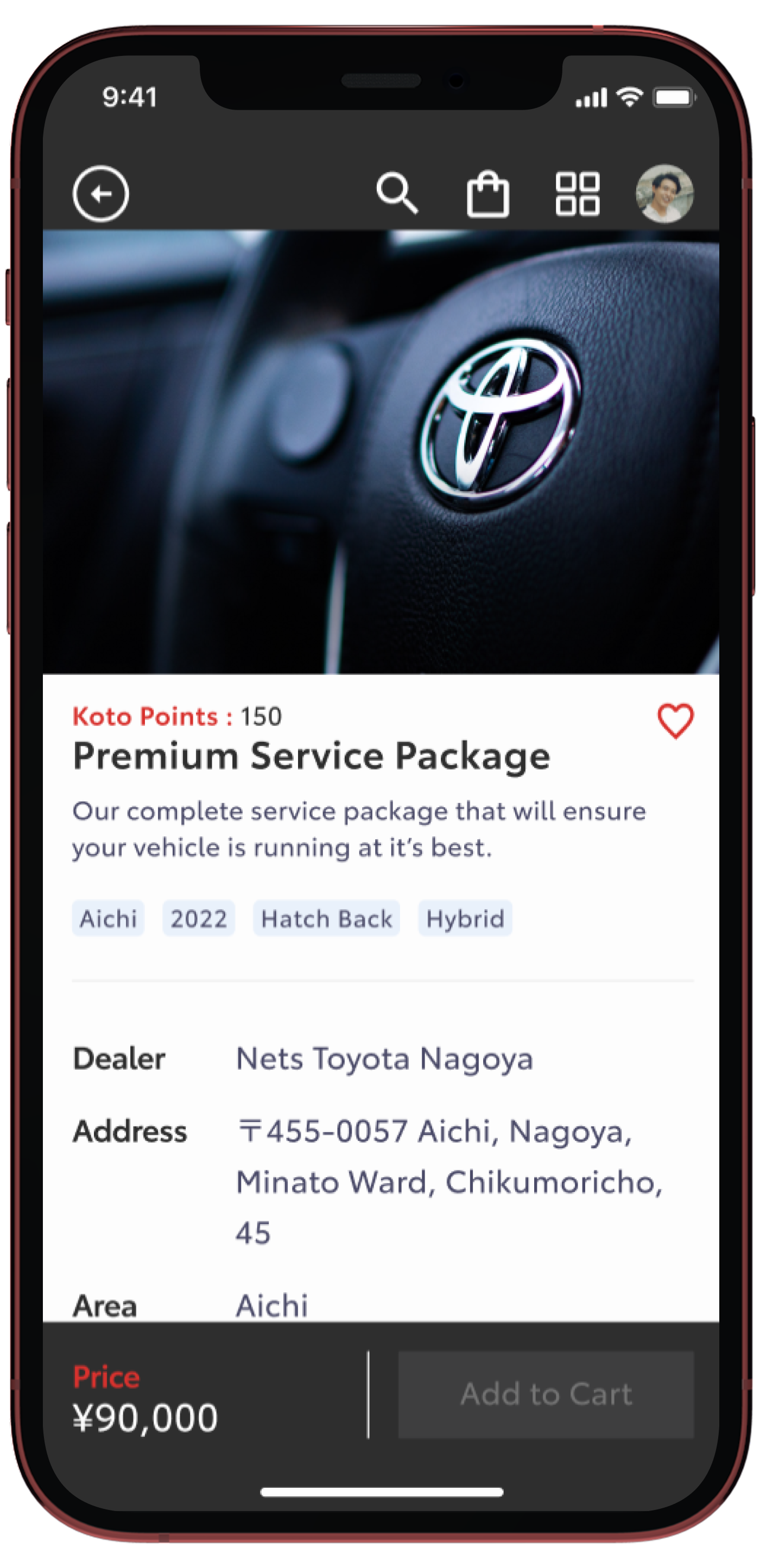
Owners browse relevant services, see pricing before committing, choose an available time, and receive a clear confirmation.
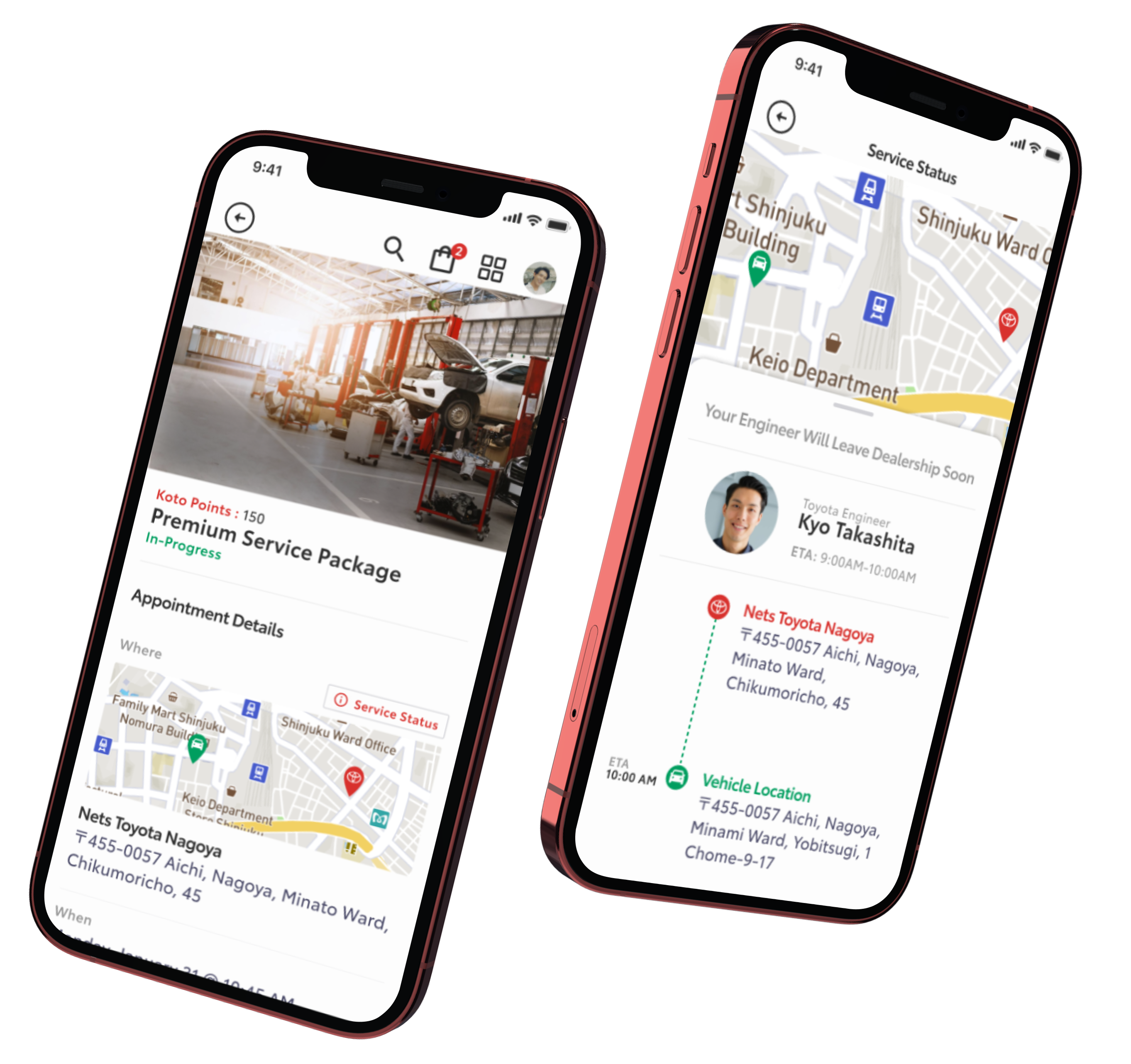
Upcoming service, appointment details, and live status remain easy to find, reducing follow-up calls.
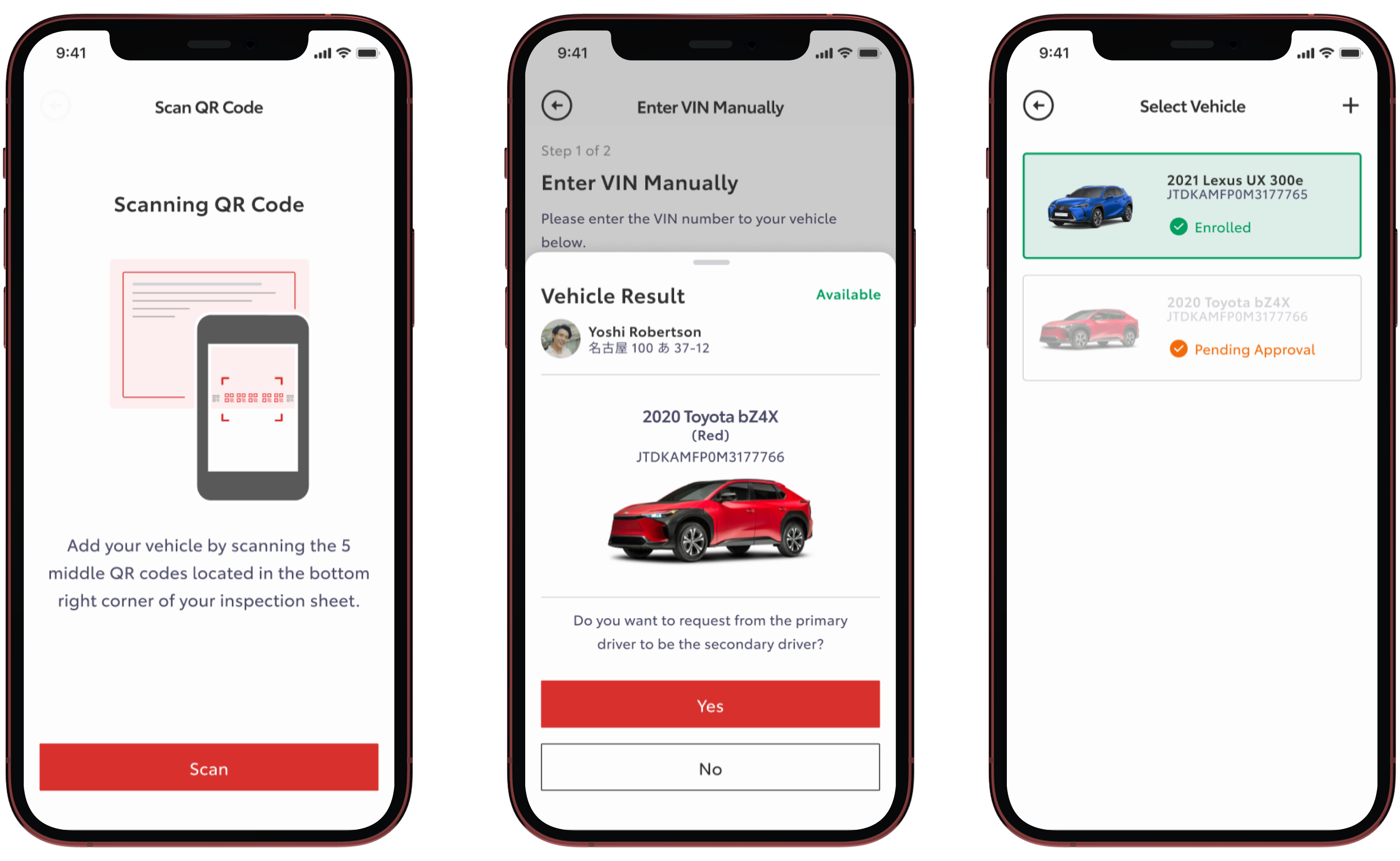
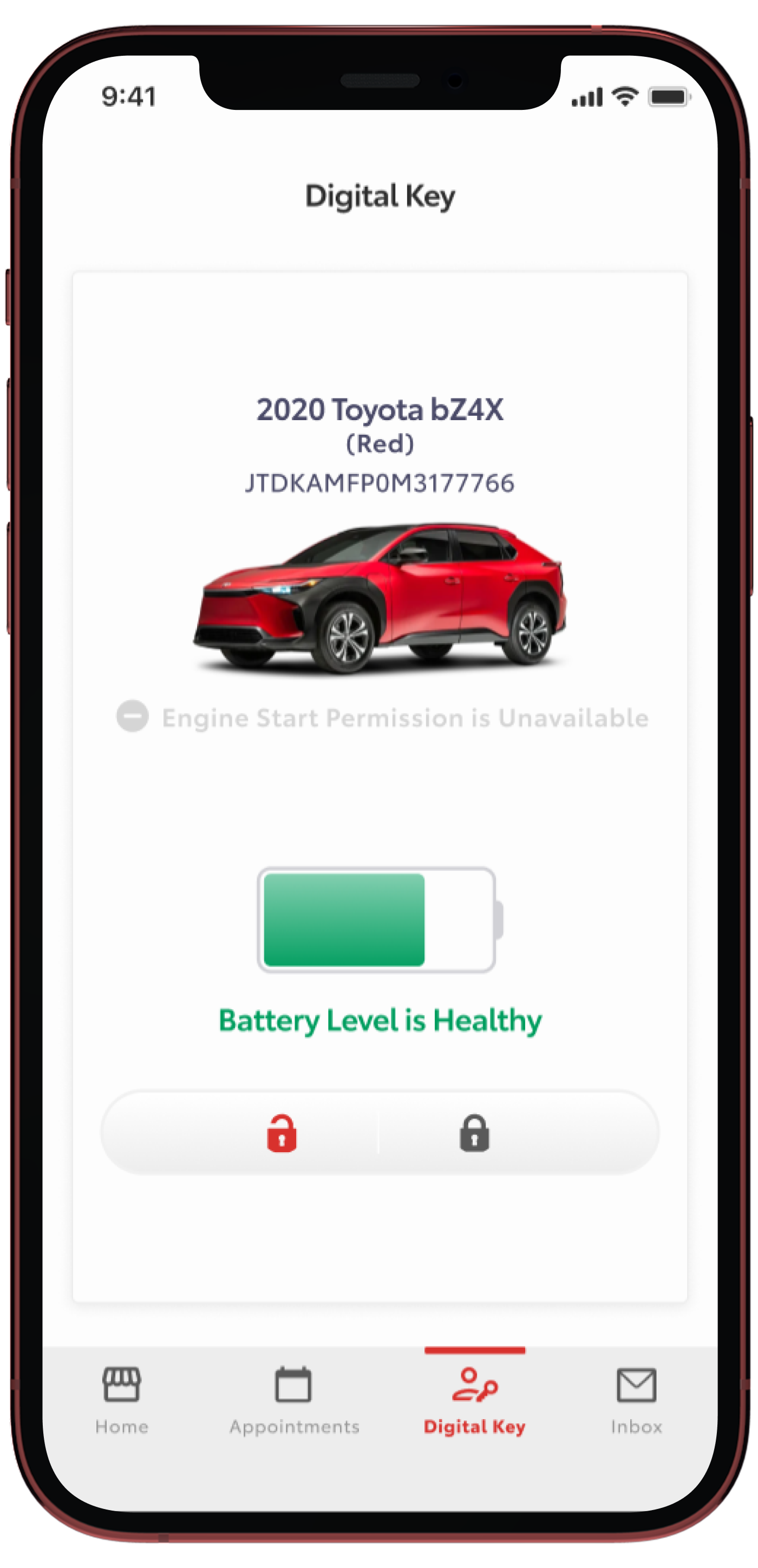
Owners can add a vehicle, understand key status, and share access for family, valet, or service without exchanging a physical key.
Iteration
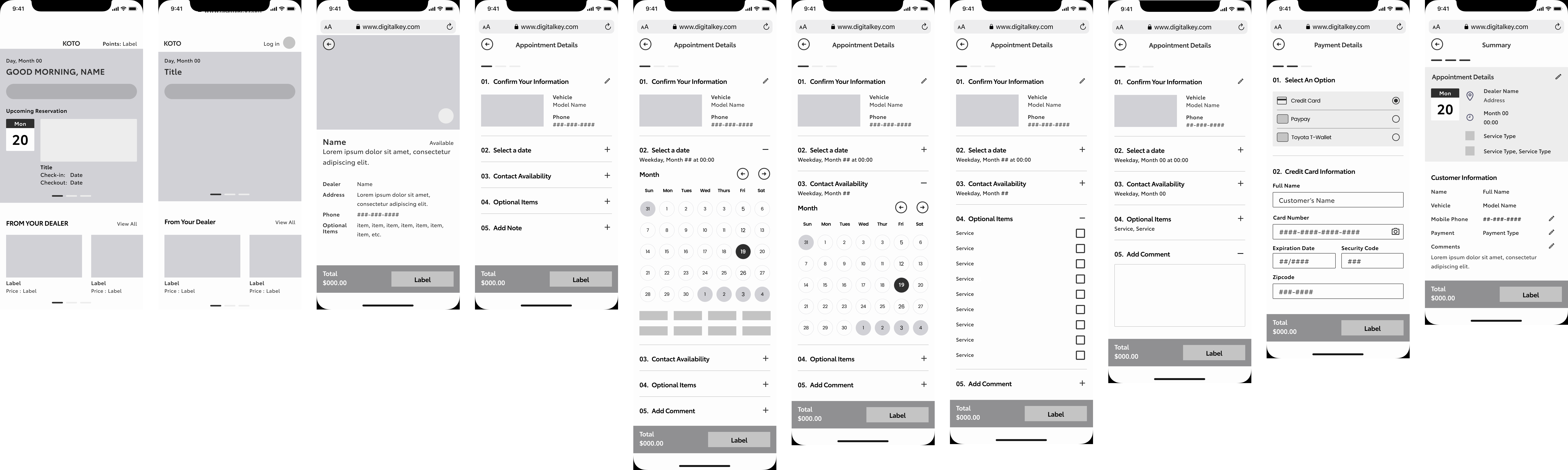
Sketches and low-fidelity flows tested how much information owners needed at each decision before visual styling entered the process.
Reported outcomes
The integrated experience improved service conversion and confidence in connected vehicle access.
Increase against the previous phone and walk-in baseline.
Among owners completing at least one service appointment.
Booking time fell from roughly 15 minutes to under five.
Strong feedback for convenience and key reliability.
In an opaque category, clarity is not a finishing touch—it is the product value. Price, status, and permission design made convenience believable.
Mileage-based maintenance recommendations, stronger digital-key recovery, and accessibility in outdoor and gloved-use contexts.
Design the relationship, not just the transaction.
Deep dive
Additional material for reviewers who want to inspect the system in more detail.
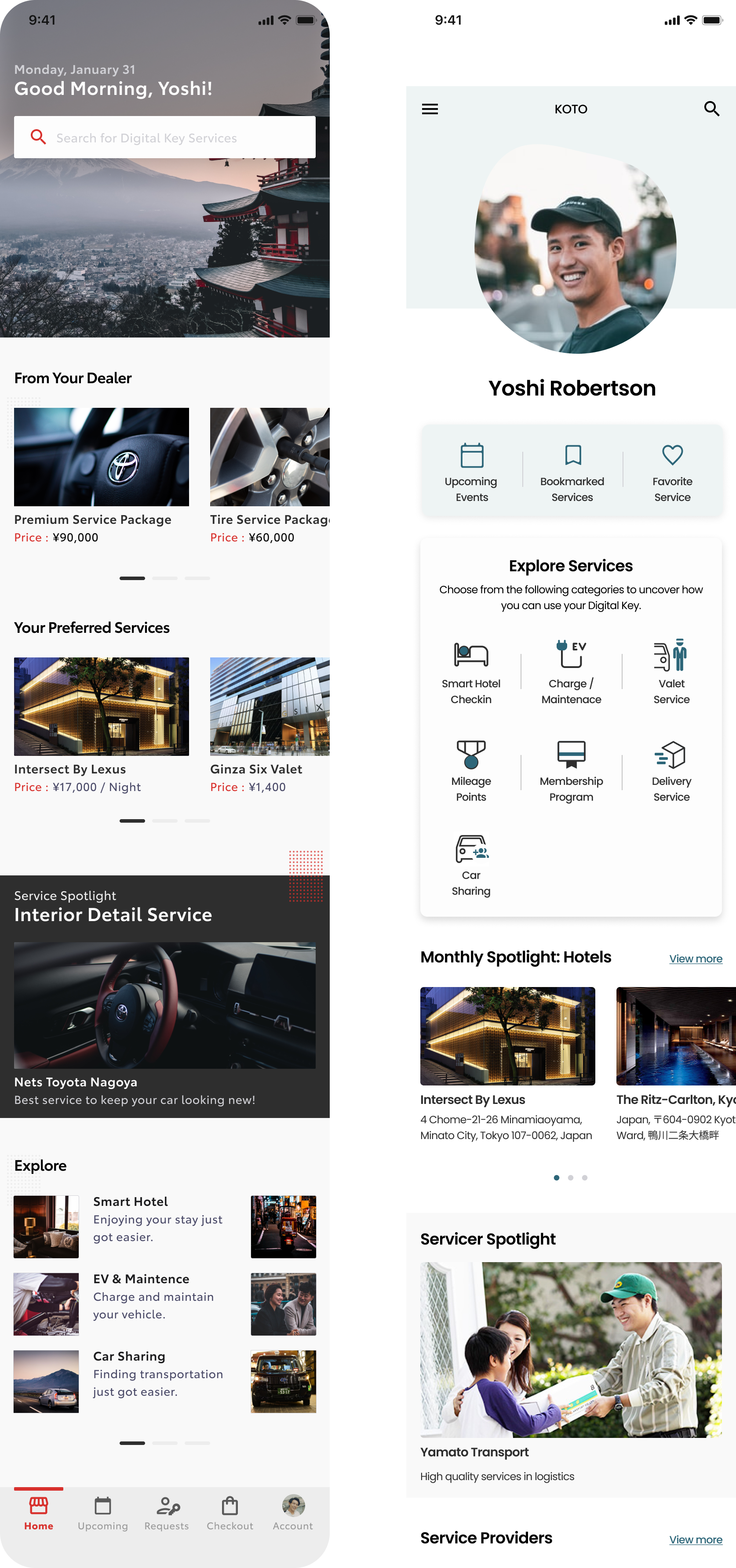
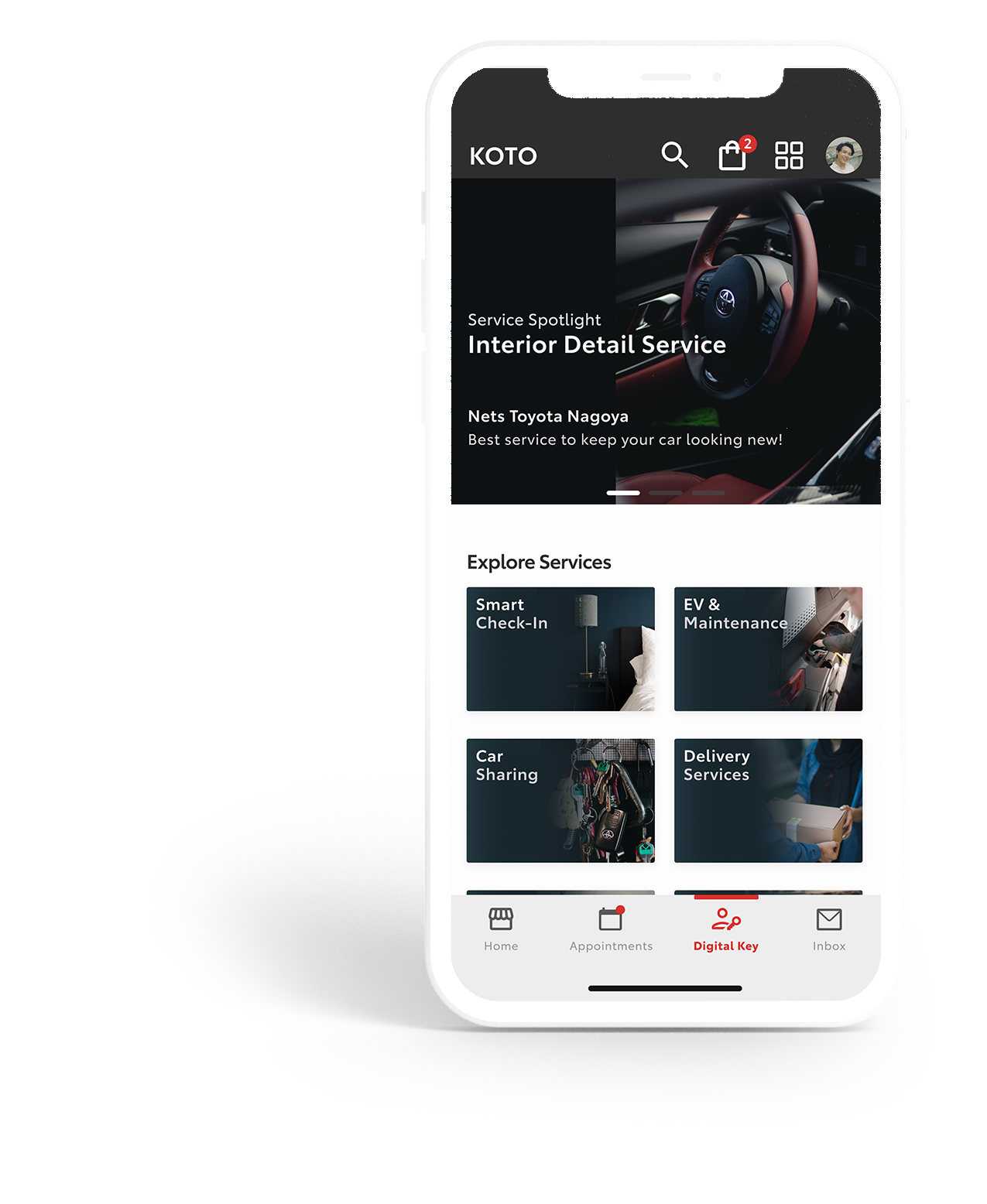
Koto is a comprehensive automotive service platform created for Toyota in Japan to modernize the vehicle ownership experience. The app combines two critical features: an online shop for automotive services and products, and a digital key system that enables contactless vehicle access and control.
Developed specifically for the Japanese market, the platform serves Toyota vehicle owners who want convenient access to automotive services while eliminating the friction of traditional physical keys and in-person service scheduling.
Design an integrated automotive service ecosystem that:
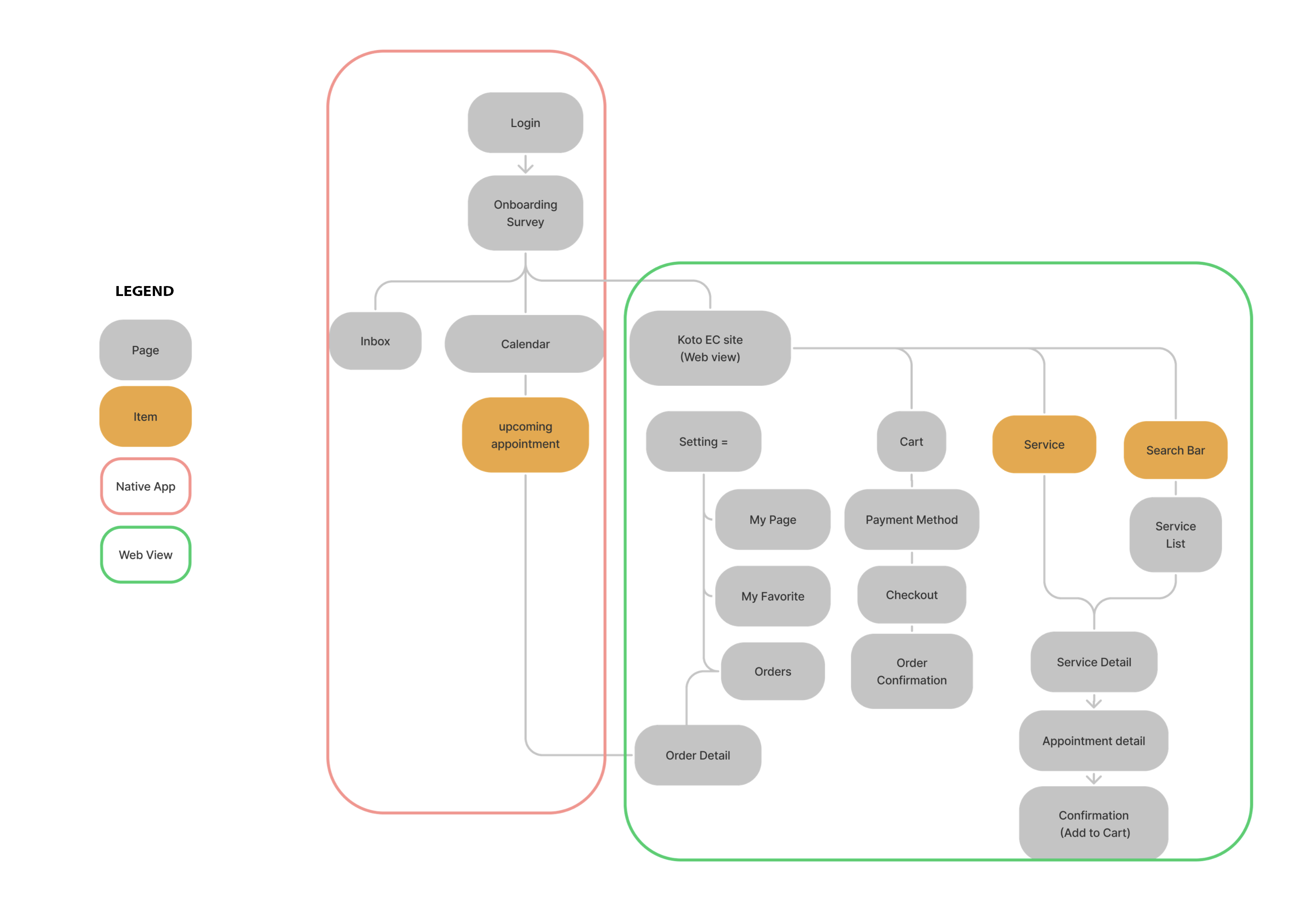
After defining the problem and pain points, my team worked together and came up with ideas, such as having an onboarding survey to better understand the users' needs for services. Combining with the client's directions, the app would have 2 main features:
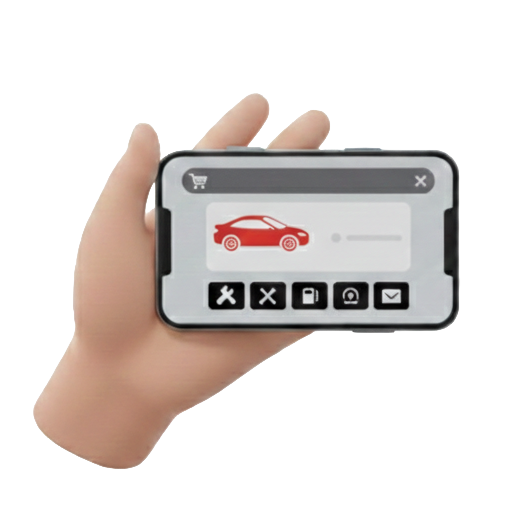
Allows users to browse, select, and purchase various automotive services
and products directly from the app
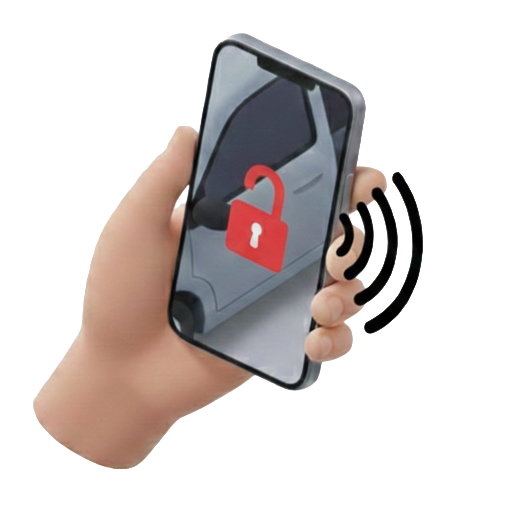
Enhance vehicle access and control via the mobile app, offering users a
contactless, secure way to unlock and start their vehicles.
I conducted comprehensive research to understand how vehicle owners currently manage automotive services and what prevents them from using digital solutions:
Spoke with 20 vehicle owners across different demographics and vehicle types
Interviewed automotive service centers to understand operational constraints
Evaluated existing solutions like Tesla app, Openbay, and YourMechanic
Studied how users currently schedule services and what friction points exist
Hidden fees were the #1 complaint about traditional automotive service. Users wanted to see complete pricing before committing to a service appointment. Many avoided digital booking because they feared surprise charges.
Research revealed that 67% of users still preferred in-person scheduling—not because they wanted to visit in person, but because phone calls were frustrating and existing digital solutions were clunky. The average booking took 15 minutes across multiple phone calls and confirmation emails.
Users struggled with dropping off keys for service appointments, coordinating pickup times, and sharing access with family members. Service centers also cited key management as a significant operational burden.
Vehicle owners wanted personalized service recommendations based on their mileage and time intervals, but this information was rarely available. They had to remember maintenance schedules manually or rely on reminder stickers.
Research showed 67% of users preferred in-person service scheduling, revealing opportunity for digital convenience
Nearly even split between staff and online preferences suggested need for hybrid approach
Design Opportunity: The research revealed a clear opportunity: users wanted digital convenience but existing solutions created more friction than they solved. By addressing price transparency, streamlining booking, and integrating digital key technology, we could create a service experience that actually reduced effort rather than adding complexity.
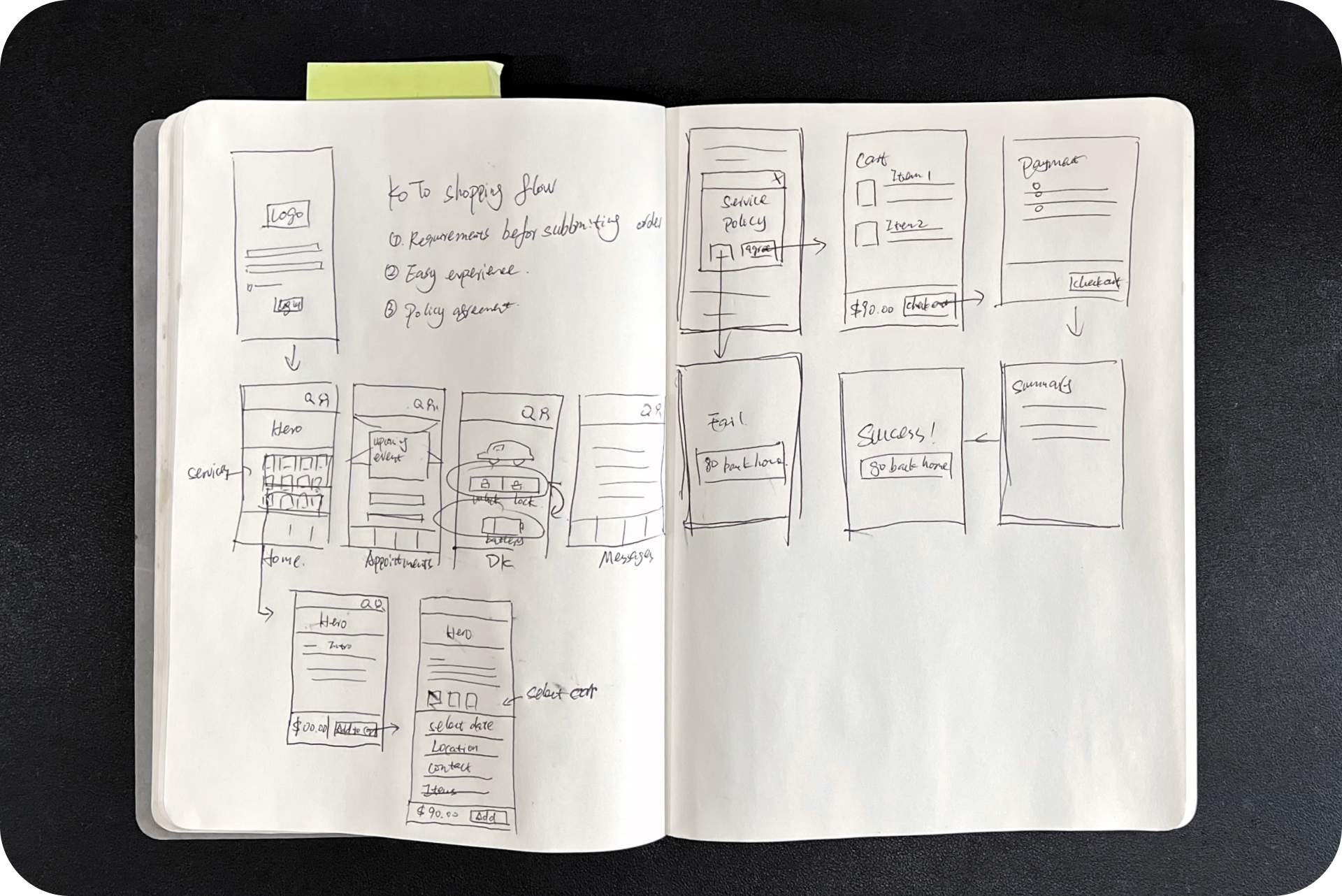
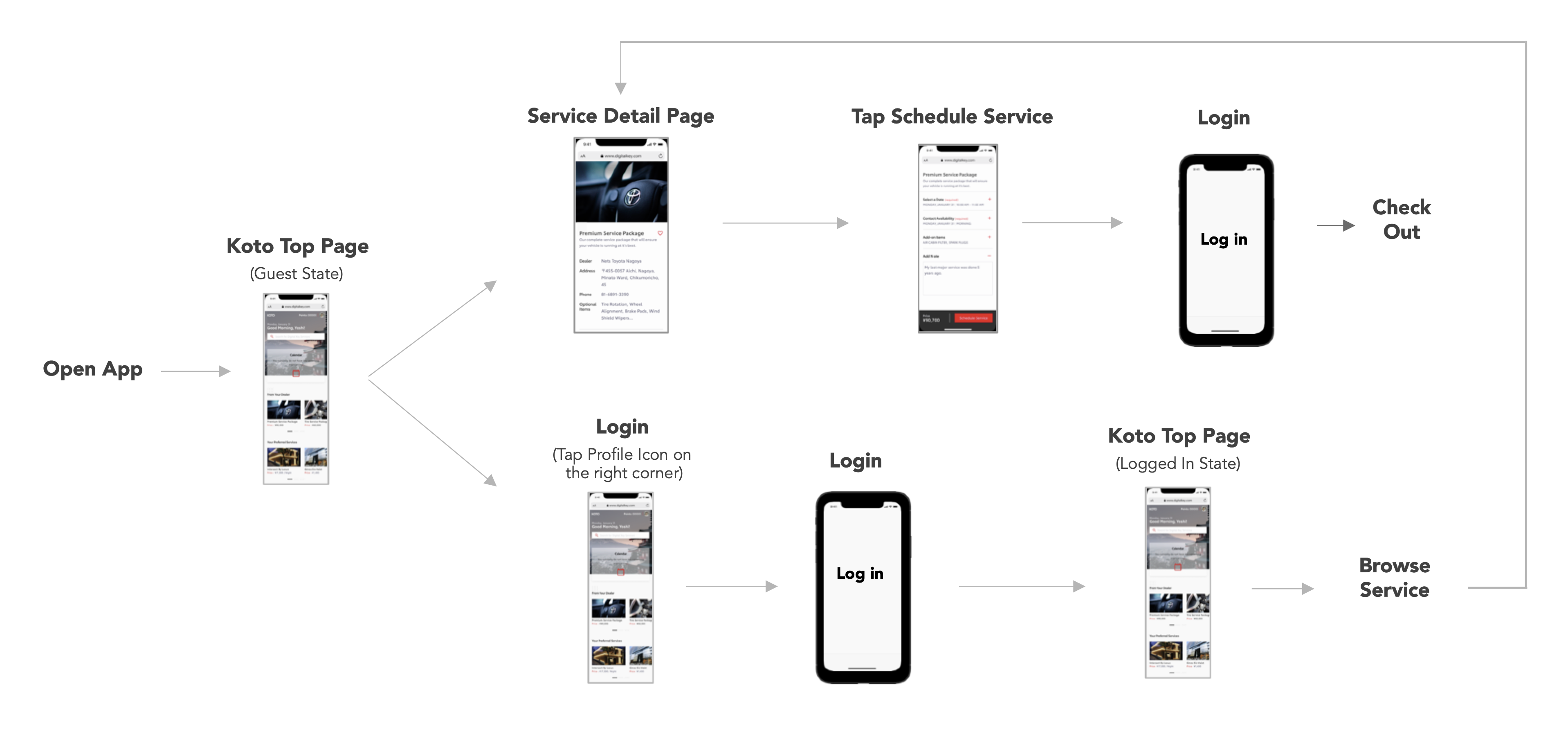
Based on the research insights, I mapped out comprehensive user journeys focusing on the mobile app experience:
Started with wireframes to map out the complete service booking flow, from vehicle information entry to appointment confirmation. This phase focused on establishing information architecture and user flow logic.
Explored different visual directions for the home screen and service discovery interface. Tested multiple layout approaches to find the optimal balance between service promotion and user navigation.
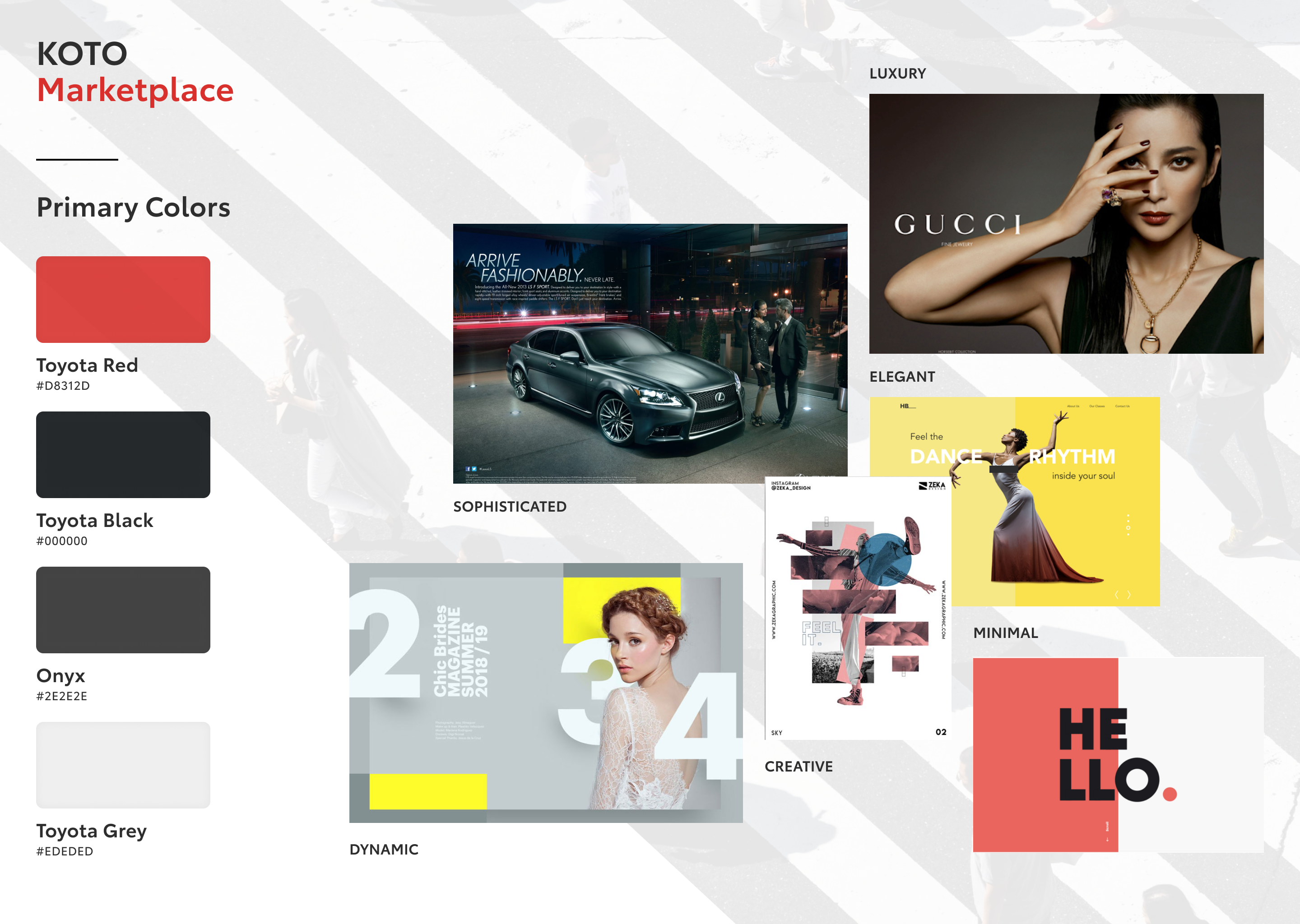
Established the visual direction drawing inspiration from luxury, sophistication, and dynamic automotive design. The mood board guided decisions around elegance, minimalism, and creative presentation.
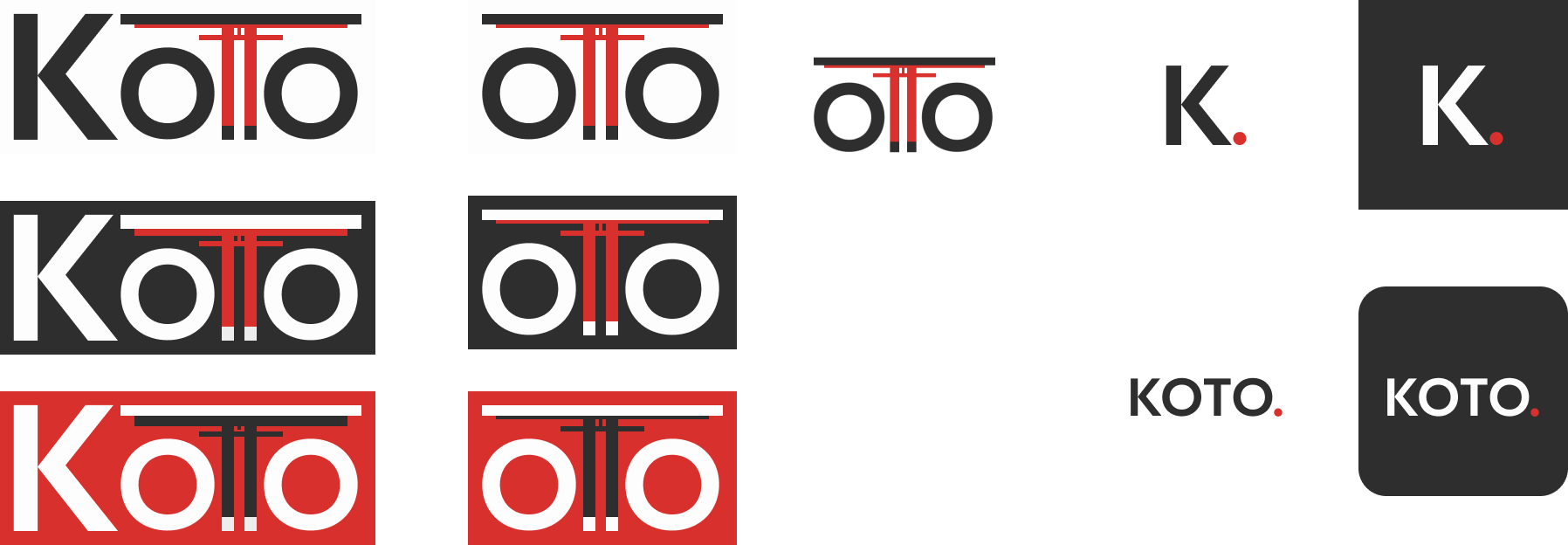
Developed multiple logo variations with different approaches. The final wordmark uses a clean, bold typeface with a distinctive red dot accent following "KOTO." This simple yet memorable design creates strong brand recognition while maintaining versatility across light and dark backgrounds.
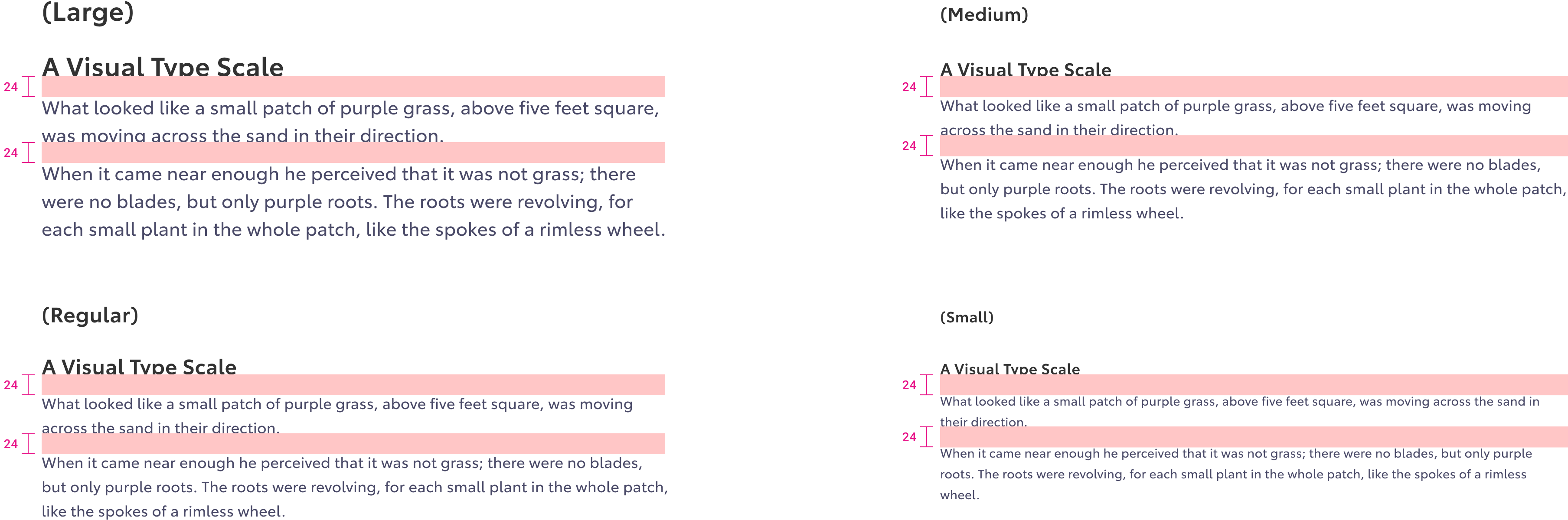
Established a visual type scale with clear hierarchy across four sizes (Large, Medium, Regular, Small) ensuring readability and consistency across all touchpoints.
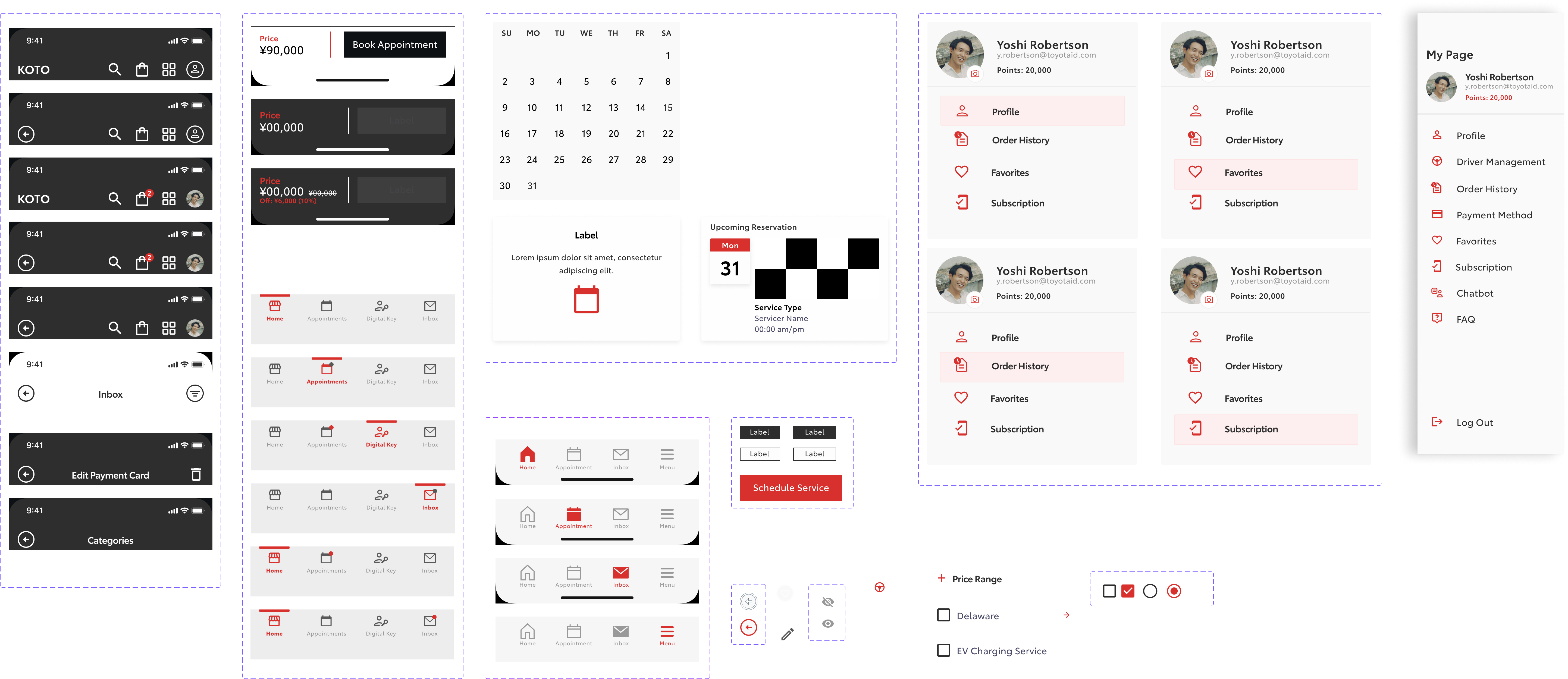
Built a comprehensive design system with reusable components including navigation bars, pricing cards, calendars, booking forms, and profile elements. This ensured consistency across the platform while enabling rapid iteration.
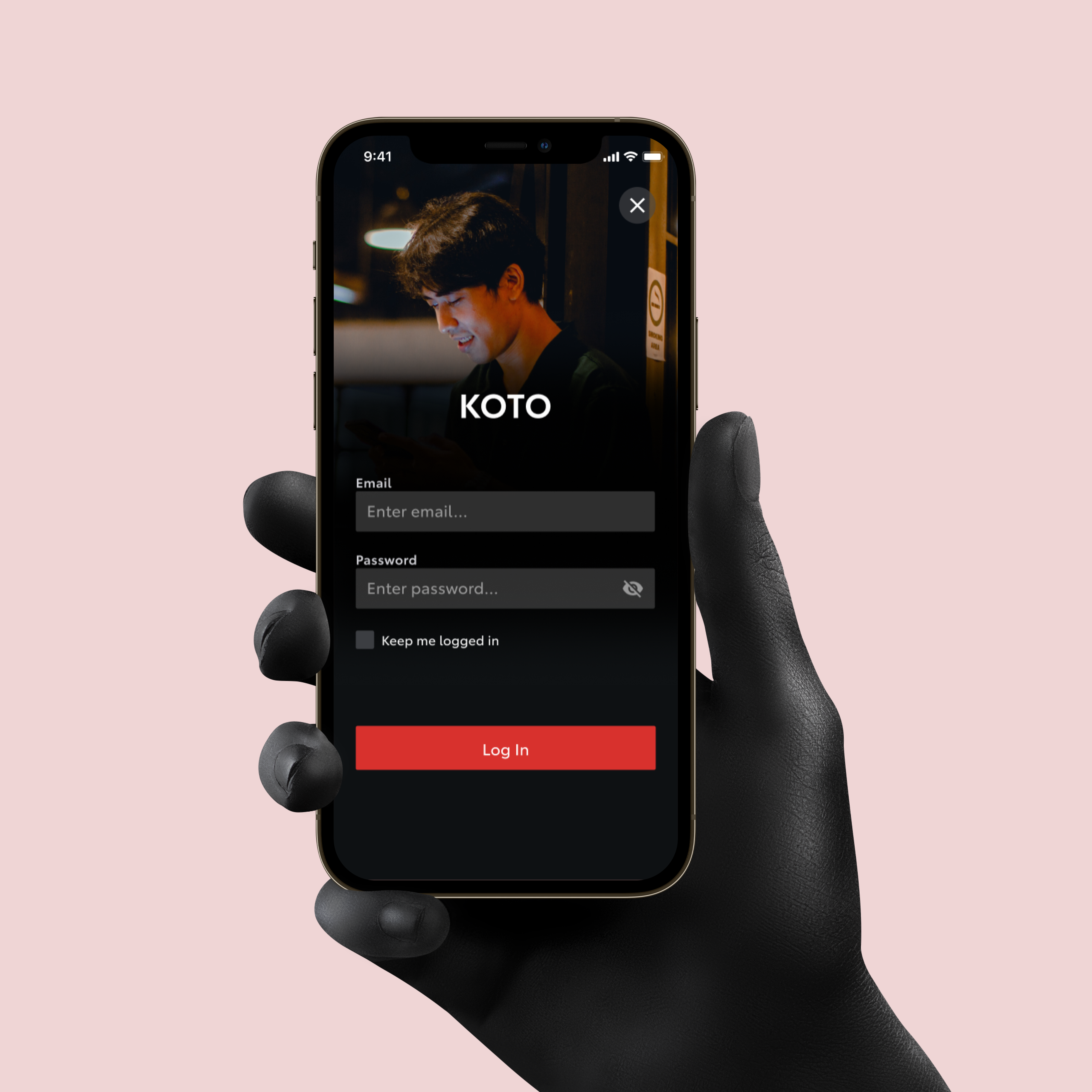
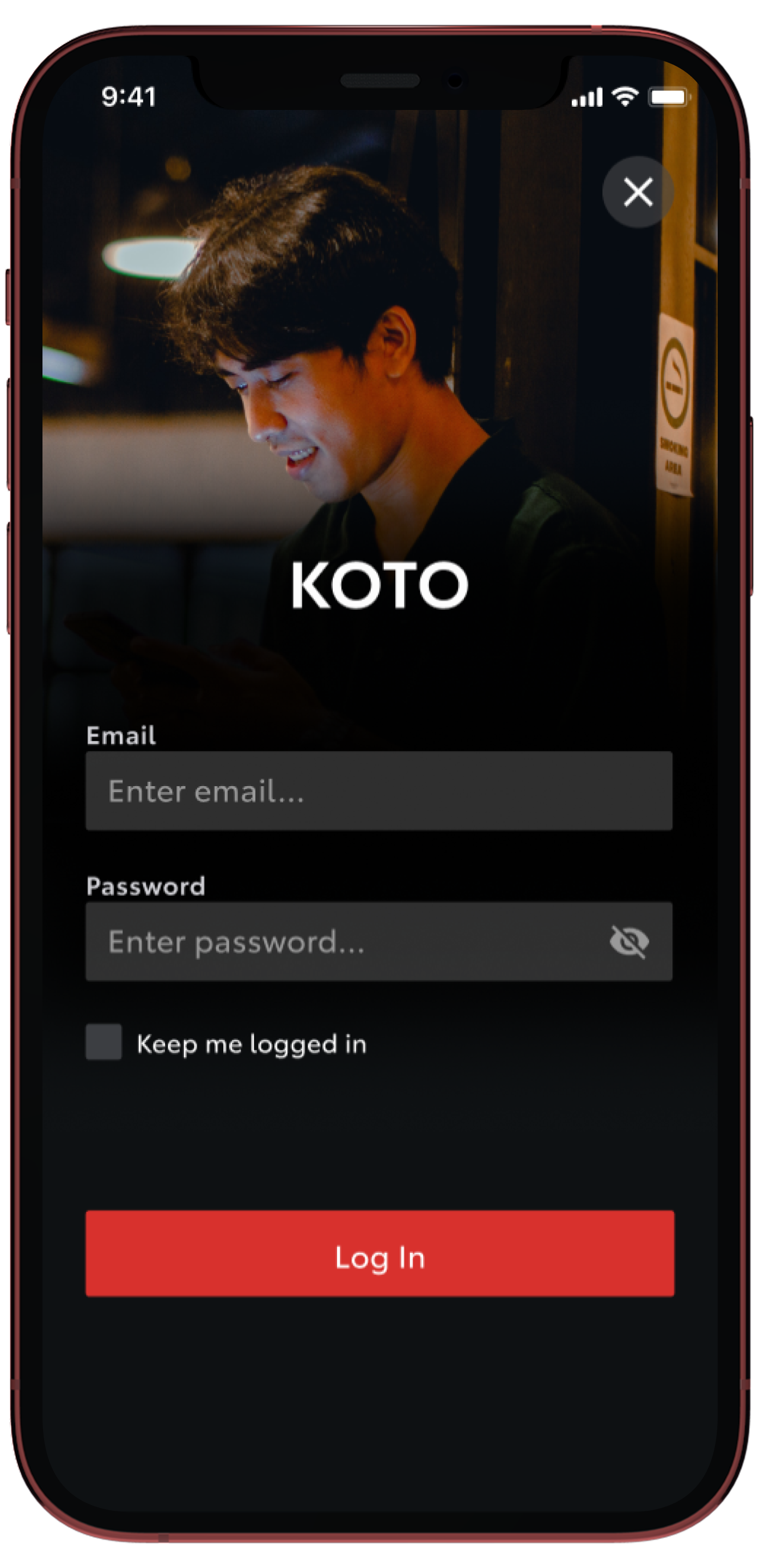
Optimized login experience balances security with convenience for quick access to the platform.
The home screen brings together all essential features in a cohesive interface, providing quick access to services, appointments, and vehicle management.
Streamlined booking experience with transparent pricing and instant availability information.
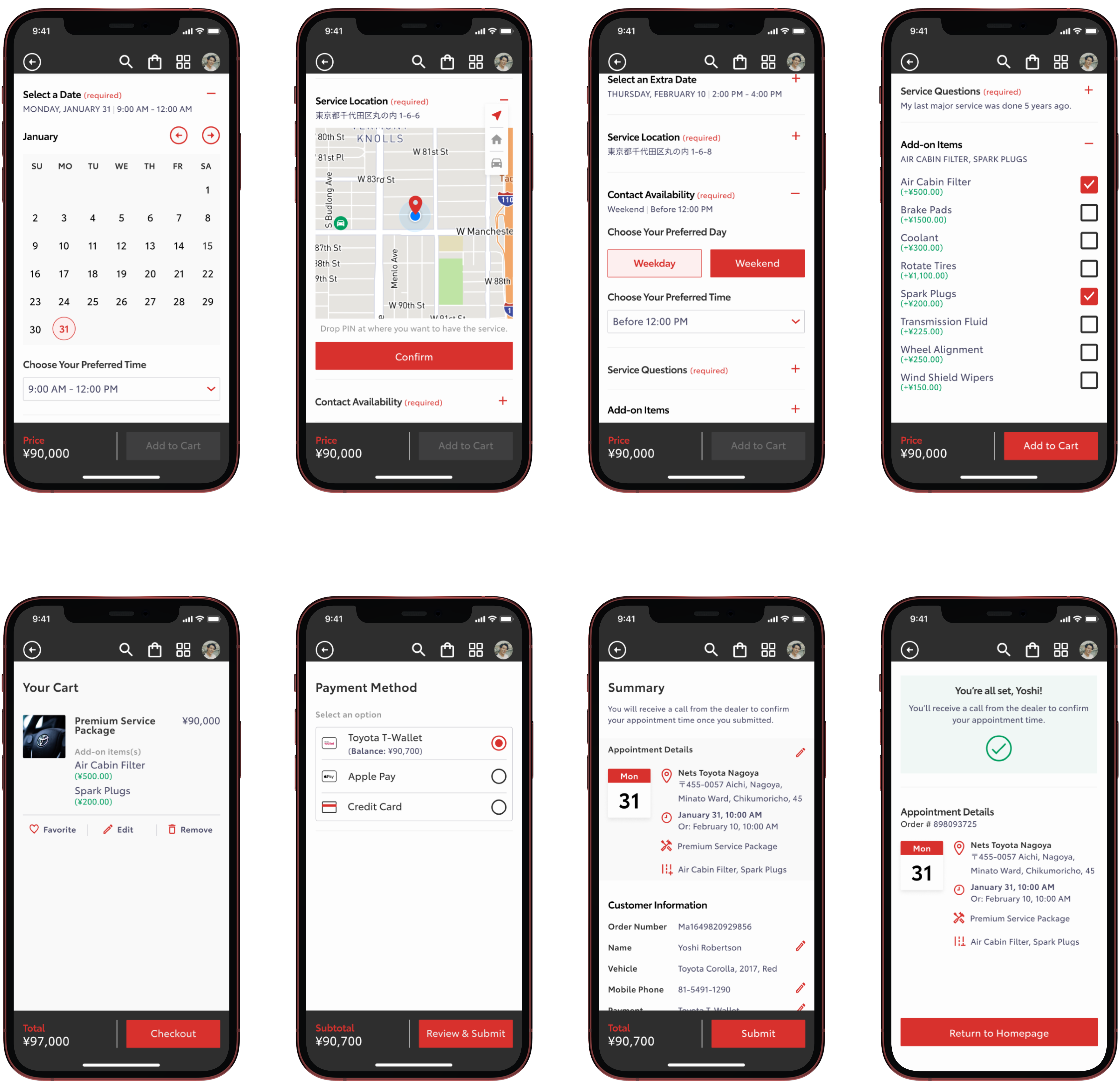
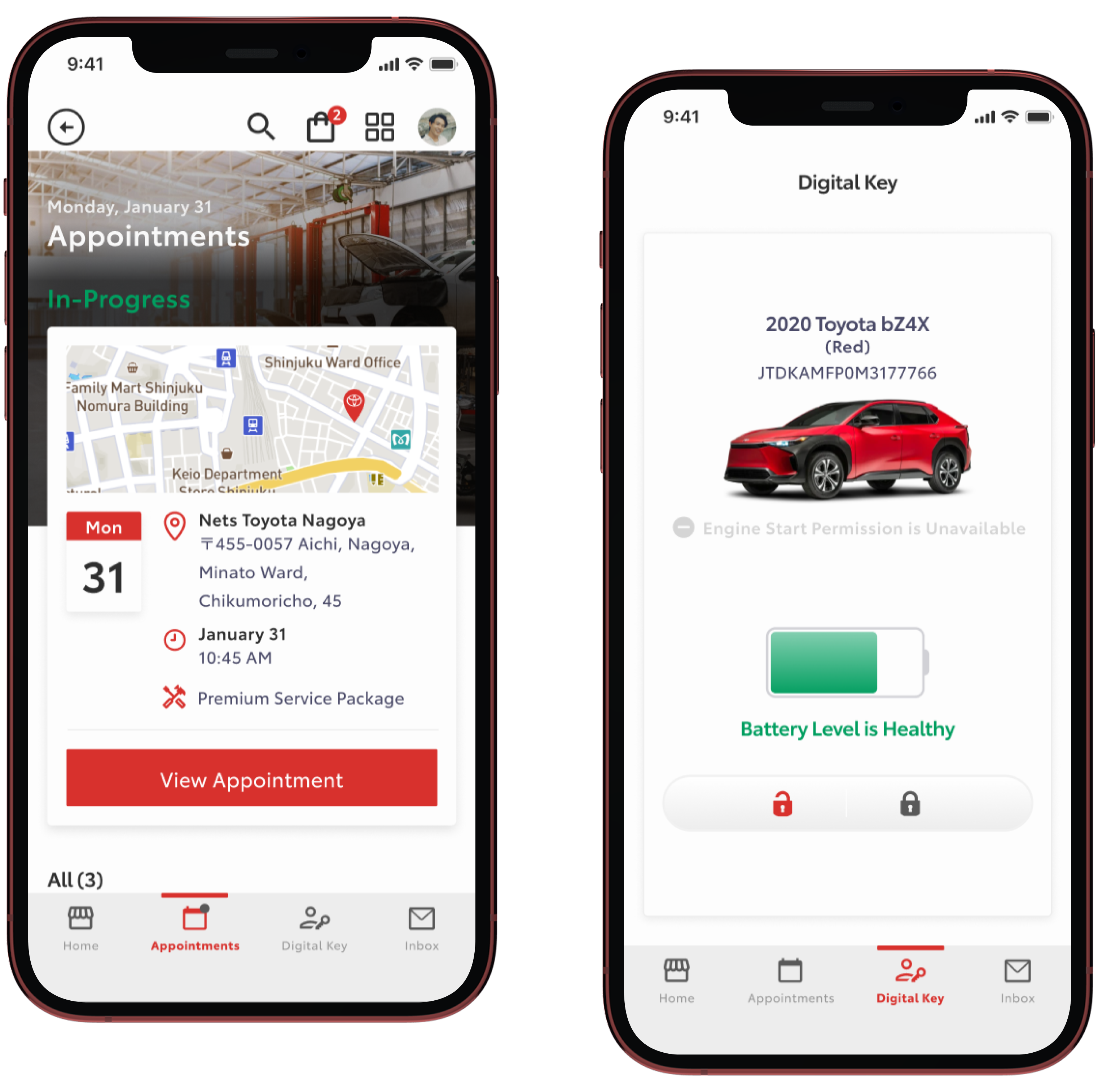
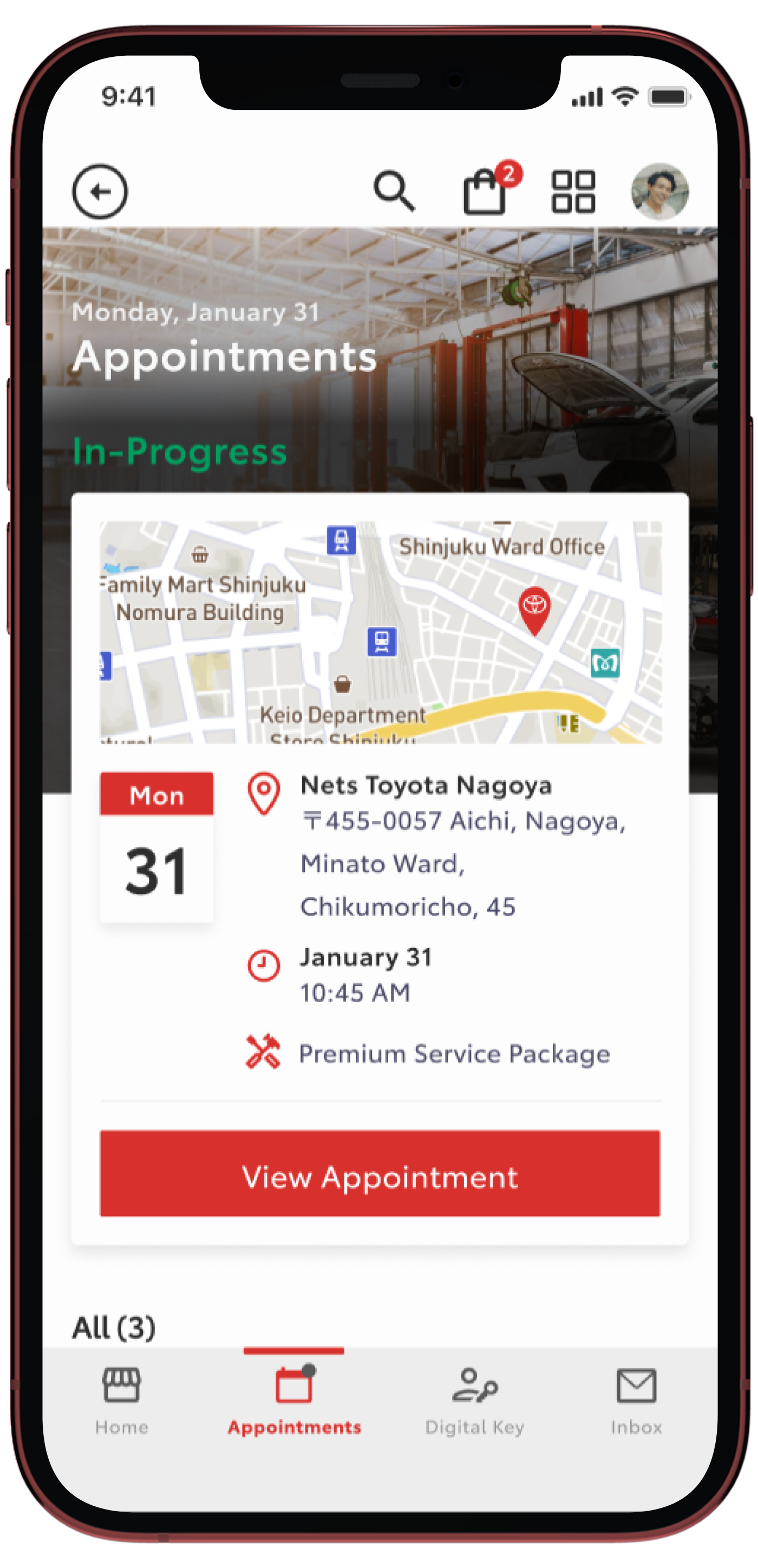
Comprehensive appointment tracking with real-time updates reduces friction in scheduling and managing service appointments.
Secure, contactless digital key functionality enables modern vehicle access and sharing, eliminating the limitations of physical keys.
Compared to pre-app baseline of phone and walk-in bookings, demonstrating reduced friction in scheduling
Among users who completed at least one service appointment, showing strong trust in contactless technology
Average booking completion time reduced from 15 minutes (phone) to under 5 minutes (app)
Highly rated with consistent praise for convenience and digital key reliability
Users who booked once returned for additional services within 6 months, indicating strong satisfaction
35% higher than traditional phone bookings due to service bundling and product cross-selling
Koto successfully unified e-commerce and digital key technology into a seamless automotive platform. The results—45% increase in bookings, 82% digital key adoption, and 3.5x faster checkout—validate that reducing friction drives adoption.
Clear pricing was the most impactful factor in service bookings. Similarly, explaining digital key security increased adoption by 35%. In traditionally opaque industries, transparency builds competitive advantage.
Users engaging with both features had 3x higher retention. Automatic key sharing during service bookings created a cohesive experience that felt seamless rather than fragmented.
Automotive usage demands specific considerations—high contrast for outdoor visibility, large touch targets for gloves, and proximity-based unlock. Understanding the physical environment is essential.